How often should you post on LinkedIn? A pace you can keep with a small audience
The data says two to five posts a week, even for small accounts. Here's what that means in practice, the 4-1-1 and 95-5 rules, and a starter week you can copy.

On this page
- How often should you post on LinkedIn?
- Can you post too much on LinkedIn?
- What changes when your audience is small?
- A starter posting week you can copy
- The 4-1-1 rule and the 95-5 rule
- Which post formats earn more per post?
- How to stay consistent when posts get no engagement
- Keep posting with people in the same boat
- FAQ
Post on LinkedIn two to five times a week. Buffer's analysis of 2 million+ posts from 94,000+ accounts found that moving from one post a week to two to five added about 1,182 impressions per post, and that the lift held for small accounts too. Start at two posts a week you can keep, add daily comments on other people's posts, and add a third post only once two feels easy.
How often should you post on LinkedIn? The largest public study says two to five times a week, and that it works for small accounts as well as big ones. What the study can't tell you is how to keep that pace when your posts get three likes. This guide covers the data, the popular rules of thumb (4-1-1 and 95-5), a starter week you can copy, and why the people around your posts matter as much as the number.
How often should you post on LinkedIn?
Post two to five times a week. Buffer's data scientist Julian Winternheimer analysed more than 2 million LinkedIn posts from 94,000+ accounts and compared each account's busy weeks with its own quiet weeks. Moving from one post a week to two to five was the first step that clearly improved results per post.
| Posts per week | Extra impressions per post vs 1 a week | Engagement rate change |
|---|---|---|
| 2 to 5 | +1,182 | +0.23 percentage points |
| 6 to 10 | +5,001 | +0.76 percentage points |
| 11 or more | +16,946 | +1.40 percentage points (about 3x the engagements) |
Two details make this more useful than most frequency advice. First, the comparison is within the same account, so it isn't just big accounts posting more. Second, Buffer says the relative lift held for accounts with "a few hundred followers" as well as those with tens of thousands.
“Post as often as you can, as long as the quality stays high. Low-quality content posted frequently won’t yield great results.”
Can you post too much on LinkedIn?
According to Buffer's data, not in the way people fear. It found no point where more posts made each post perform worse. The gains do shrink as you climb: the jump from one post to two to five is bigger than the jump from six to ten to eleven or more. The real limit is you. Eleven good posts a week is a full-time job, and a weaker post doesn't get rescued by frequency.
What changes when your audience is small?
For a founder or consultant with a few hundred followers, I'd start at two posts a week and hold it for eight weeks before adding a third. That's my judgement, not a study. The reason is simple: the number that predicts results is the one you can keep. A two-post week you keep for three months beats a five-post week you abandon in the second.
Small accounts have a problem the data hides. When a post goes out to a small network, the first people who see it decide a lot about who sees it next, and there may only be a handful of them. That's why a small account needs a second habit alongside posting: showing up on other people's posts.
A starter posting week you can copy
Here's the week I'd give anyone starting from a small audience: two posts, and three thoughtful comments a day on posts by people your buyers follow.
- Pick two fixed days. Tuesday and Thursday work for many people, but the fixed part matters more than the days.
- Write both posts on one day. Batch them on Sunday or Monday so a busy week can't skip a post.
- Make a list of 20 people your buyers follow. These are the posts you'll comment on.
- Comment three times a day, before or after your own post. Add a point, a question or an example. "Great post" doesn't count.
- Tell someone your plan. An accountability partner or small group checks in weekly on whether you did both. A 2016 meta-analysis of 138 studies found that progress reported to others is followed through more often.
- Review every four weeks. Look at impressions per post and profile views, not only likes. Add a third post only once two feels easy.
The 4-1-1 rule and the 95-5 rule
The 4-1-1 rule and the 95-5 rule are content-mix rules, not frequency rules: 4-1-1 says most posts should give value rather than promote, and 95-5 says most of your buyers aren't ready to buy yet. Neither tells you how often to post. Both tell you what to post.
What is the 4-1-1 rule?
The 4-1-1 rule says that for every one self-serving post, you share four pieces of useful content and one re-share. It was coined by Andrew Davis of Tippingpoint Labs and Joe Pulizzi, founder of the Content Marketing Institute, originally for Twitter. On LinkedIn, I read it as: most of your posts should teach or tell a story, and only a few should sell.
What is the 95-5 rule?
The 95-5 rule comes from Professor John Dawes of the Ehrenberg-Bass Institute: at any given time only about 5% of your potential B2B buyers are in the market, and the other 95% aren't ready to buy yet. For LinkedIn, the lesson is to post so that the 95% remember you when they are ready, rather than pitching every week to the 5%.
Which post formats earn more per post?
Carousels, videos and images all earn more per post than plain text. Format doesn't change how often to post, but it changes the return on each post. Buffer's same analysis found images earned about 72% more engagement than text posts, videos about 84% more than text, and carousels (PDF document posts) the most of all. If you can only make two posts a week, making one of them visual is a cheap upgrade.
How to stay consistent when posts get no engagement
Most people who stop posting on LinkedIn don't stop because they ran out of ideas. They stop because a few posts in a row go out to silence. Three things help:
- Judge by the month, not the post. Single posts swing wildly. Four weeks of impressions per post is a fairer read.
- Measure inputs you control. Posts published and comments left are fully in your hands. Likes aren't.
- Don't post alone. Have people at your stage who see your posts and whose posts you see. That's the whole idea behind an accountability group, and why a single accountability partner helps even more when your goal is public.
Reminder apps help with the first two. They can't help with the third, which I cover in accountability apps vs peer groups.
Keep posting with people in the same boat
Early Days Club is a members-only club for founders and consultants growing on LinkedIn. You pick up to three audiences you want to reach, and your posts go into the daily lists of members who match them. The people you support are never the people who support you.
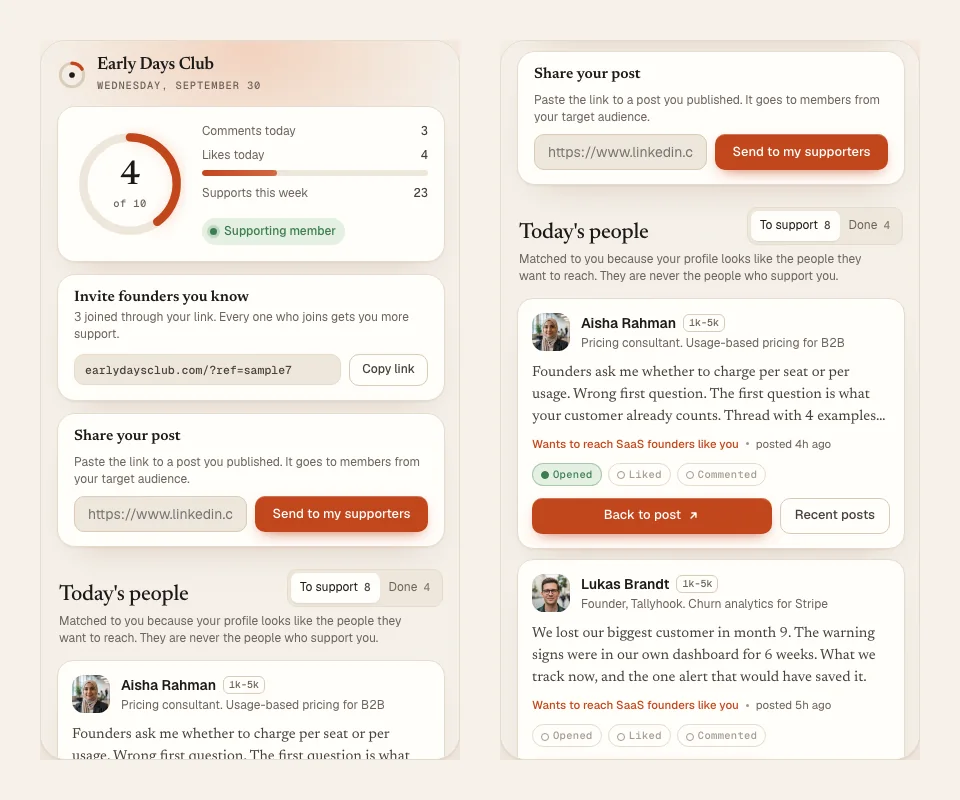
- Your commenting habit, built in. A short daily list of members' posts, each with a note on why it's there, and Suggest for three comment ideas you edit and post yourself.
- Your posting habit, supported. Paste your post's link and support arrives over the day as members come online.
- Your choice, always. Nothing is posted for you. Every like and comment is a member's own, in their own tab. Go quiet and your posts pause until you're back.
Frequently asked questions
Do I need to post on LinkedIn every day?
No. Buffer's study of 2M+ posts found the first clear lift comes from moving from one post a week to two to five. Daily posting can do more, but only if quality holds. For most founders, two or three good posts a week plus daily commenting is a better trade.
Is posting twice a day on LinkedIn too much?
Buffer's data found no point where posting more made each post perform worse, and its top tier was 11 or more posts a week. The practical limit is quality and your time. If a second daily post is weaker than the first, skip it.
How many times a week should a small account post on LinkedIn?
Two to five times a week, starting at two. Buffer found the relative lift from posting more held for accounts with a few hundred followers as well as large ones. Pick the number you can keep for three months, then add one.
How long should a LinkedIn post be?
LinkedIn allows up to 3,000 characters per post. There's no length that reliably wins, so write as long as the idea needs and cut anything that repeats. A clear first two lines matter most, because that's what shows before the see more link.
Is 10,000 impressions on LinkedIn a lot?
It depends on your network. For an account with a few hundred followers, 10,000 impressions on one post is a strong result. Compare each post with your own four-week average of impressions per post rather than with other people's numbers.
What is the 4-1-1 rule on LinkedIn?
For every self-promotional post, share four useful pieces of content and one re-share. Andrew Davis and Joe Pulizzi coined it for Twitter, and on LinkedIn it's a reminder that most of your posts should teach or tell a story rather than sell.
I build products for founders who grow on LinkedIn, including LigoSocial and Early Days Club. The idea behind the club came from my own two-week experiment: I stopped posting and left a few thoughtful comments a day instead, and my profile views tripled. These articles are what I have learned about showing up consistently when your audience is still small.
Sources
- Buffer: How often should you post on LinkedIn? (2M+ posts, 94,000+ accounts)
- Ehrenberg-Bass Institute: The 95:5 rule, why B2B growth starts long before the purchase
- Contently: Should your social media strategy follow the 4-1-1 rule?
- Harkin et al. (2016), monitoring goal progress meta-analysis, Psychological Bulletin (PubMed)
- Buffer: How Often to Post on LinkedIn in 2026 (YouTube)