Accountability partners: how to find one, and why a small group keeps you posting
The research is clear that reporting progress to another person helps. Here's how to set that up, and what changes when your goal is posting on LinkedIn consistently.

On this page
- What is an accountability partner?
- What does an accountability partner actually do?
- Does having an accountability partner really work?
- Types of accountability partners compared
- How to find an accountability partner
- A weekly check-in script you can copy
- An accountability partner for LinkedIn posting
- Why a small group beats one buddy for posting
- Where Early Days Club fits
- FAQ
An accountability partner is someone you agree to report your progress to on a fixed schedule, so a promise to yourself becomes a promise to another person. The reporting is what works: in Gail Matthews' Dominican University study, people who sent weekly progress reports to a friend scored 7.6 on goal achievement versus 4.28 for those who only thought about their goals. Find a peer at your stage, agree one measurable goal, and check in weekly for a four-week trial.
An accountability partner works because they turn a promise you made to yourself into one you made to someone else. Most articles stop at "find a buddy". This one covers what the research actually measured, how to find a partner and run the first four weeks, a check-in script you can copy, and the version I care most about: staying consistent with posting on LinkedIn when almost nobody is reacting yet.
What is an accountability partner?
An accountability partner is a person you agree to report to, on a fixed schedule, about a specific goal. They don't do the work, and they don't have to be an expert. Their job is to be the person you'd feel awkward telling "I didn't do it this week".
“An accountability partner is someone who supports another person to keep a commitment or maintain progress on a desired goal.”
The term grew up in evangelical Christian circles before it spread into coaching, fitness and business, according to the same Wikipedia entry. Today you'll also hear accountability buddy, goal buddy or check-in partner. They all mean the same thing. When three or more people do it together, it's an accountability group.
What does an accountability partner actually do?
A good accountability partner does four things, and none of them is nagging:
- Holds the commitment. They know exactly what you said you'd do and by when, so "I'll get to it" stops being enough.
- Checks in on a schedule. Weekly is the most common rhythm. The check-in is the product, so it happens even in weeks with nothing to report.
- Gives honest feedback. They notice patterns you can't see, like always slipping in the same week of the month.
- Shows up for the wins too. Early progress is invisible to everyone except the person watching closely. That's them.
What they don't do: plan your work, rescue you, or punish you. If you want someone to design the plan, you want a coach. The comparison table further down covers the difference.
Does having an accountability partner really work?
Yes, with one important detail: the effect comes from reporting progress to another person, not from having a buddy in the abstract. The best-known experiment on this is Gail Matthews' goals study at Dominican University of California. She randomly split participants into five groups and followed them for four weeks. The group that sent weekly progress reports to a supportive friend scored highest on goal achievement, well ahead of the group that only thought about their goals.
| Group in the Matthews study | What they did | Mean goal achievement |
|---|---|---|
| 1 | Thought about their goals, didn't write them down | 4.28 |
| 2 | Wrote their goals down | 6.08 |
| 3 | Wrote goals and action commitments | 5.08 |
| 4 | Sent goals and commitments to a friend | 6.41 |
| 5 | Sent goals, commitments and weekly progress reports to a friend | 7.6 |
“Those who sent weekly progress reports to their friend accomplished significantly more than those who had unwritten goals, wrote their goals, formulated action commitments or sent those action commitments to a friend.”
A much larger body of evidence points the same way. A 2016 meta-analysis in Psychological Bulletin pooled 138 studies with 19,951 participants and found that monitoring your progress improves goal attainment (effect size d = 0.40), and that the effect was larger when progress was reported or made public and physically recorded. An accountability partner is the simplest way to make your progress public to at least one person.
University of Chicago behavioural scientist Ayelet Fishbach put the reason plainly in an NPR interview:
“We know that people work in groups. People have been working in groups from the beginning of time.”
Types of accountability partners compared
The right type depends on how much structure you need and what you can spend. Here's how the common options compare for someone trying to keep a creative or business habit going.
| Type | Cost | Best for | Where it breaks |
|---|---|---|---|
| Friend or partner | Free | Simple habits where kindness helps | They go easy on you, and they don't share your goal |
| Peer at your stage | Free | Work goals where they understand the context | Hard to find, and one busy month ends it |
| Accountability group | Free to paid | Keeping going through dips, because someone is always active | Drifts without a clear format |
| Coach | Typically $90 to $500 a month | Complex goals that need a plan, not only a witness | Expensive, and the relationship is one-way |
| App | Free to about $40 a month | Solo tasks with a clear yes or no | Easy to ignore, and a notification isn't a person |
If you're weighing apps specifically, I tested the main categories in accountability partner apps vs peer groups.
How to find an accountability partner
Finding one takes about 30 minutes of intent and a four-week trial. The most common mistake is asking a close friend who doesn't share your goal. Look for someone in the same boat instead.
- Pick one measurable goal. "Post twice a week on LinkedIn for four weeks" works. "Build my personal brand" doesn't, because nobody can check it.
- List people at your stage. Good places to look: people who regularly comment on your posts, members of a cohort or course you took, founders in the same niche Slack or Discord, and threads like r/GetMotivatedBuddies on Reddit.
- Ask for a four-week trial, not forever. "Want to swap weekly check-ins for a month and see if it helps?" is an easy yes. A lifetime commitment is an easy no.
- Agree the format in writing. Day, time, channel (a call, a voice note or a text) and what each check-in covers. Use the script below.
- Decide what happens when someone misses. Not a punishment, a rule. For example: a missed check-in means you owe a written update by the next morning.
- Review at week four. Keep going, change the format, or end it kindly. Ending a partnership that isn't working is part of the process.
A weekly check-in script you can copy
A check-in should take ten minutes, not an hour. The simplest format that holds up is three questions each, in the same order every week:
- What did I say I'd do last week, and did I do it? Yes or no first, then one sentence.
- What got in the way? One obstacle, not a list.
- What will I do by next check-in? Specific enough that your partner could check it.
Your partner's only job is to listen, ask one follow-up question, and write your answer to question 3 down so they can read it back to you next week. That written line is the "progress report" the Matthews study measured.
An accountability partner for LinkedIn posting
Posting consistently is a strange goal, because the hard part usually isn't writing. It's what happens after you publish: nothing. You refresh, the post sits at three likes, and the obvious conclusion is that nobody wants to read you. That's the moment most founders stop.
A classic accountability partner helps with the first half. They make sure you publish on the days you promised. But they can't fix the second half on their own, because one person can't make a post feel seen. For posting, the most useful accountability partner does two jobs:
- Keeps you to your cadence. You agree a number, for example two posts a week, and they check it. If you're unsure what number to pick, start with how often you should post on LinkedIn when your audience is small.
- Shows up on the post. They read it and, when they have something real to add, leave a thoughtful comment. That turns "posting into silence" into a conversation.
Why a small group beats one buddy for posting
One accountability partner is a single point of failure. They get a new job, go on holiday or lose interest, and the partnership quietly ends, usually taking your streak with it. A small group of peers at your stage keeps going when one person is busy, because someone is always around.
For posting, a group has a second advantage: more of the right people see your post. The value of attention on LinkedIn depends on who it comes from. Likes from old classmates don't tell anyone that your post is for heads of sales. Comments from people who look like your buyers do. That's why the accountability groups that work for creators are organised around audience, not just around encouragement.
Where Early Days Club fits
Early Days Club is a members-only club for founders and consultants growing on LinkedIn, built on the idea above: support from people in the same boat, organised around who you want to reach. You pick up to three audiences. Your posts go into the daily lists of members who match them, and you support posts from members who want to reach people like you. The people you support are never the people who support you.
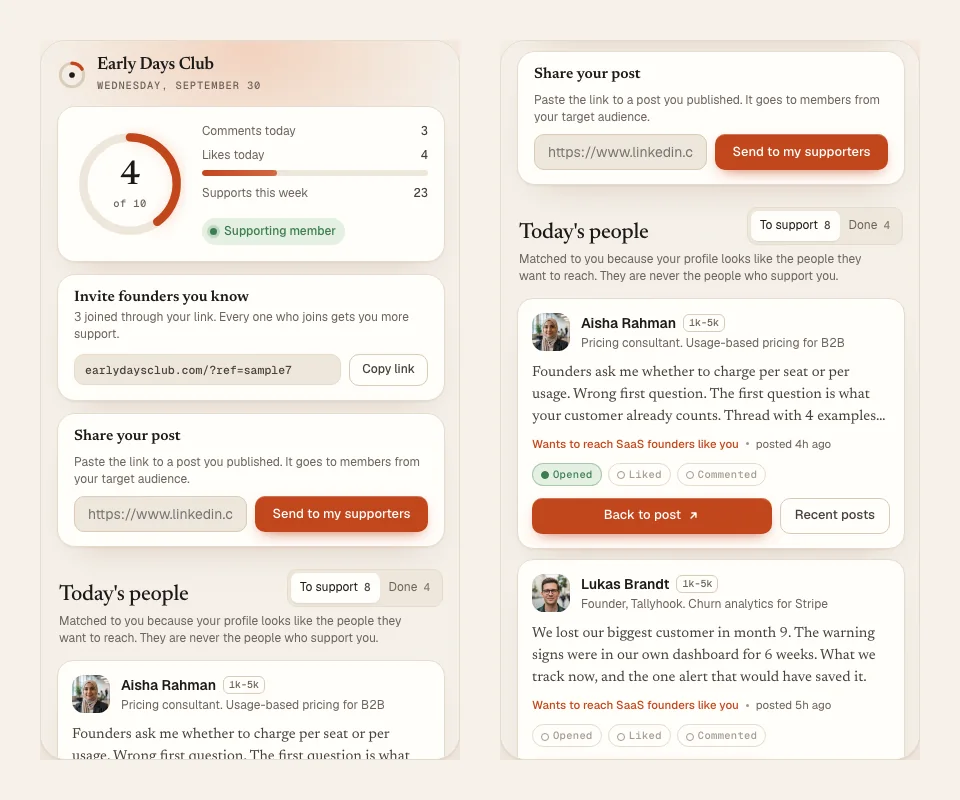
A few things matter for the accountability angle:
- A short daily list. The side panel shows today's posts from members, each with a note on why it's on your list, and a link straight to the post.
- Comment ideas you edit yourself. Click Suggest in a comment box for three ideas written for that post. Nothing is ever posted for you.
- Real people, real choices. Every like and comment is a member's own, made in their own LinkedIn tab, on posts they decide to engage with.
- A built-in cadence. Keep supporting members and your posts keep going on lists. Go quiet and your posts pause until you're back.
It won't write your posts, and nobody can promise you a number of likes or a level of reach. What it gives you is the thing a single accountability partner can't: a steady supply of people like your buyers who see what you publish, and a daily reason to show up for them in return.
Frequently asked questions
What is the role of an accountability partner?
To hold a specific commitment for you and check on it at an agreed time. A good partner listens, asks one honest follow-up question and records what you promise for next time. They don't plan your work or punish you. That's a coach's or a manager's job.
What are the 5 C's of accountability?
There isn't one agreed list. Different coaches and management books use different versions, and it isn't a research framework. The elements that show up in most versions, and in the Matthews study, are a clear goal, a commitment made to someone else, regular check-ins and an agreed consequence for missing one.
What is another word for an accountability partner?
Accountability buddy is the most common, followed by goal buddy, check-in partner and, in study and work settings, body double. When three or more people do it together, it's an accountability group or, if the group also advises each other on strategy, a mastermind.
Can you give me an example of an accountability partner?
Two founders who both want to post on LinkedIn twice a week agree to a ten-minute call every Monday. Each says whether they hit last week's target, what got in the way and exactly which two posts they'll publish this week. Between calls, each reads the other's posts and comments when they have something real to add.
How often should you check in with an accountability partner?
Weekly is the default because it's frequent enough to catch a slipping week and light enough to last. Daily check-ins work for short sprints of a week or two. Monthly is usually too slow, because by the time you talk, the month is already lost.
Can an accountability partner be a stranger online?
Yes, and it often works better than a close friend, because a stranger with the same goal won't go easy on you. Start with a four-week trial and agree the format in writing. Online communities built around one goal, like a niche Discord or a founder club, are the easiest place to find one.
Is it better to have one accountability partner or a group?
One partner is simpler and more personal. A small group is more resilient, because one person's busy week doesn't end it. For posting on LinkedIn, a group also means more of the right people see your posts, which a single partner can't provide.
I build products for founders who grow on LinkedIn, including LigoSocial and Early Days Club. The idea behind the club came from my own two-week experiment: I stopped posting and left a few thoughtful comments a day instead, and my profile views tripled. These articles are what I have learned about showing up consistently when your audience is still small.
Sources
- Wikipedia: Accountability partner
- Gail Matthews, Goals Research Summary, Dominican University of California (PDF)
- Harkin et al. (2016), Does monitoring goal progress promote goal attainment? A meta-analysis, Psychological Bulletin (PubMed)
- NPR Life Kit: The power of an accountability buddy to help get things done (2025)
- r/GetMotivatedBuddies, Reddit's accountability partner finder
- GoalsWon pricing (coach price range)
- Simon Sinek on accountability partners (YouTube)