Accountability groups: how they work, and how to run one that lasts
A small group keeps going when any one person is busy. Here's the format, the size, the agenda and the questions that make one last past the first month.

On this page
- What is an accountability group?
- How does an accountability group work?
- How many people should be in an accountability group?
- Accountability group vs accountability partner vs mastermind
- How to start an accountability group
- A 30-minute accountability group agenda
- Good questions to ask in an accountability group
- Accountability group activities that keep it useful
- Online accountability groups for founders and creators
- Why accountability groups fall apart
- An accountability group built around your audience
- FAQ
An accountability group is a small group, usually four to eight people, that meets on a fixed schedule so each member states a goal, reports progress and commits to a next step out loud. It works because progress reported to others is followed through more often: a 2016 meta-analysis of 138 studies found bigger effects when progress was made public. Keep it weekly, put updates before discussion, and write every commitment down.
An accountability group is the version of an accountability partner that survives a busy month. Instead of one person checking on you, a small group checks on each other, so the habit keeps going when any one member is away. Below: how the good ones run, how big they should be, a 30-minute agenda, the questions worth asking, and what changes when the group exists to keep its members posting online.
What is an accountability group?
An accountability group is a small group of people who meet on a fixed schedule to state goals, report progress and support each other in following through. Each member works on their own goal. The group's job is to make sure everyone says out loud what they'll do, and then comes back to say whether they did it.
That out-loud part is what the research supports. A 2016 meta-analysis of 138 studies and 19,951 participants in Psychological Bulletin found that monitoring progress improves goal attainment, and that the effect is larger when progress is reported to others or made public. A group is a reliable way to report to others every single week.
“Through a combination of good encouragement and friendly rivalry, we hold each other accountable to be there.”
How does an accountability group work?
Most accountability groups follow the same loop: commit, report, adjust, repeat. The details vary, but the groups that last share four habits.
- A fixed, protected time. Same day, same time, every week. A Sandler Training post on running one says to "lock it in now and keep it sacred".
- A short round of updates. Each member reports on last week's commitment before any discussion starts.
- A few simple metrics. The same post suggests at least three metrics per member, and the author's group reports them in a red, yellow and green format, so nobody hides behind a story.
- Written commitments. Someone records what each person promised, and reads it back next week.
Hosted online versions use the same loop in a shorter cycle. Flow Club describes its sessions like this:
“At the start of a session, the host welcomes everyone and asks each person “what are you working on?” ... When the timer ends, the host brings everyone back and asks each person, “how did it go?””
How many people should be in an accountability group?
For a weekly call, four to six people is the range I'd pick. That's my judgement rather than a study: it's small enough for everyone to speak in 20 minutes and large enough that one or two absences don't cancel the week. Mastermind groups, which spend more time on advice, are often run a little larger. Wikipedia's entry on mastermind groups says optimal groups are kept to about 8 to 10 participants with rotating leadership.
Groups that work asynchronously, in a chat or a shared doc, can be bigger, because nobody has to wait for their turn to talk. The limit there is attention: once you can't read everyone's update in a few minutes, people stop reading.
Accountability group vs accountability partner vs mastermind
The three get mixed up constantly. The simplest way to tell them apart is what happens in the room.
| Accountability partner | Accountability group | Mastermind group | |
|---|---|---|---|
| People | 2 | Usually 4 to 8 | Often 6 to 10 |
| Main activity | Check-ins on one goal each | Round of updates, commitments recorded | Advice and problem-solving on each member's business |
| Typical rhythm | Weekly | Weekly | Weekly to monthly |
| Strength | Personal, easy to start | Survives absences, peer energy | Deep advice from experienced peers |
| Weakness | One busy month ends it | Drifts without a clear format | Expensive when paid, hard to get into |
The idea of a mastermind comes from Napoleon Hill's books, where he described the "Master Mind" as two or more people working together in harmony to solve problems. If you're starting with just one other person, the accountability partner guide covers that setup.
How to start an accountability group
To start an accountability group, invite four to six people at a similar stage, agree a fixed weekly time and three simple rules, and run a four-week trial. You can have a working group within a week. The steps below assume a weekly video call, which is the easiest format to keep alive.
- Pick one shared theme. Members can have different goals, but a shared theme ("posting on LinkedIn", "shipping a side project") keeps updates understandable to everyone.
- Invite four to six people at a similar stage. Similar stage matters more than similar industry. A founder with 300 followers and one with 30,000 have different problems.
- Write down three rules. A fixed time, updates before discussion, and what happens after two missed weeks in a row. Share them before the first call.
- Choose a home for commitments. A pinned message or a shared doc where each person's promise for the week is written down.
- Run the first four weeks as a trial. Everyone agrees to a month. At the end, keep going, change the format, or close it without guilt.
- Rotate the host. One person keeps time and records commitments each week. Rotating stops the group depending on its founder.
A 30-minute accountability group agenda
Thirty minutes is enough for five people if the round of updates is strict. This is the agenda I'd start with:
- Open (2 minutes). The host reads last week's written commitments aloud.
- Round of updates (20 minutes). About four minutes each: done or not done, one obstacle, next week's commitment. No advice yet.
- Hot seat (6 minutes). The member who is most stuck gets the group's ideas.
- Record (2 minutes). The host writes down every commitment and ends on time.
Good questions to ask in an accountability group
The best questions are ones with a yes or no answer, followed by one that invites honesty. These work week after week:
- What did you commit to last week, and did you do it?
- What got in the way, and was it in your control?
- What's the one thing you'll finish before we meet again?
- What would make that easier, and can anyone here help?
- What are you avoiding right now?
- What went better than you expected this week?
Accountability group activities that keep it useful
A group that only does updates can go stale after a few months. A monthly change of format helps:
- Draft swap. Everyone shares one piece of work in progress, such as a post or a landing page, and gets two comments.
- Co-working sprint. A 60-minute call where everyone works in silence on their commitment, then reports what they finished.
- Monthly review. Each member compares the last four commitments with what they actually did and picks one change.
- Ship day. Everyone publishes or launches something on the same day and supports each other's launch.
Online accountability groups for founders and creators
Online accountability groups remove the hardest part of running one, which is finding people at your stage nearby. The common options:
| Option | How it works | Good for |
|---|---|---|
| Your own Slack, Discord or WhatsApp group | Weekly thread for commitments, optional call | Free, flexible, needs a committed host |
| Hosted coworking (Flow Club, Focusmate) | Scheduled sessions where you declare goals and work alongside others | Getting focused work done today |
| Paid cohorts and communities | A course or community with built-in groups | Structure plus learning |
| Audience-matched clubs | Members support each other's public work, organised by who they want to reach | Staying consistent with posting |
If your goal is publishing, like posting on LinkedIn every week, a general group helps with the promise but not with the silence afterwards. When a post gets three likes, the group's encouragement doesn't change who saw it. For posting, the most useful group also shows up on your work, and the most useful members are people who look like the audience you want. I cover the posting side in more detail in how often to post on LinkedIn when your audience is small.
Why accountability groups fall apart
Most groups don't end with a decision. They fade. The usual causes, and the fix for each:
| What goes wrong | The fix |
|---|---|
| Updates turn into long chats | Updates first, discussion after, with a timer |
| Attendance slides after week three | A written rule for missed weeks, agreed on day one |
| Goals are too vague to check | Each commitment must be something another person could verify |
| One member dominates | A rotating host who keeps time |
| Members are at very different stages | Invite by stage, not by friendship |
An accountability group built around your audience
Early Days Club is a members-only club for founders and consultants growing on LinkedIn. It works like an accountability group for posting, with one change: instead of a weekly call, members support each other's posts, and you're matched by who you want to reach. You pick up to three audiences, and your posts go into the daily lists of members who match them. The people you support are never the people who support you.
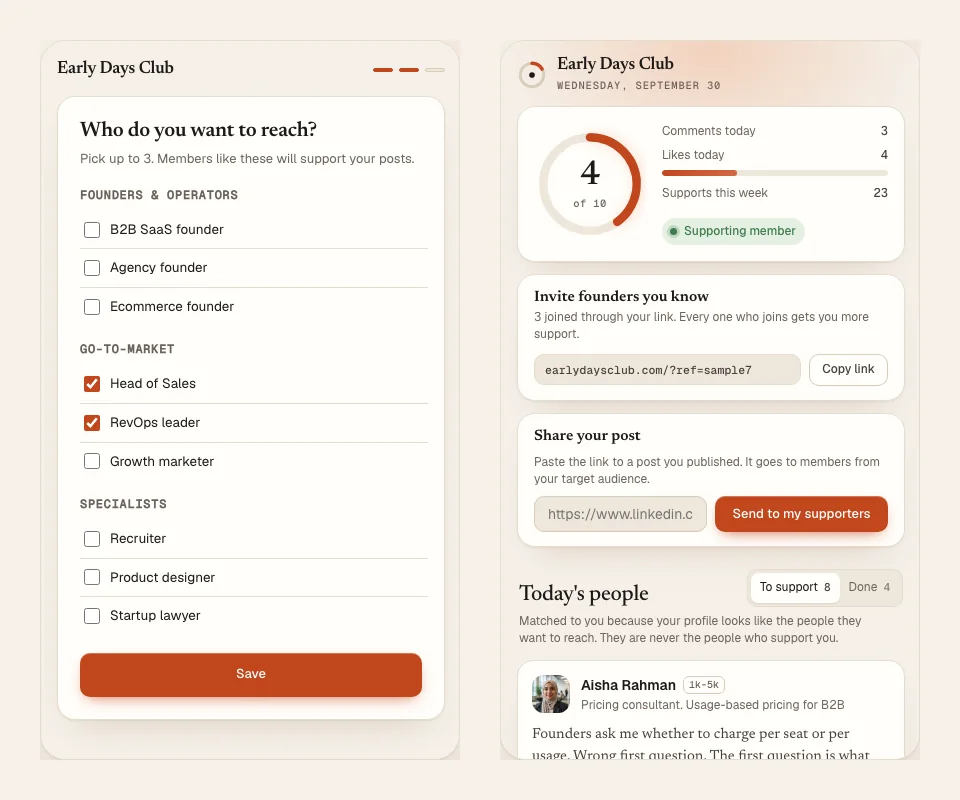
- No meeting to miss. The side panel shows a short daily list of members' posts, each with a note on why it's there.
- Comment ideas you edit yourself. Click Suggest for three ideas written for that post, make one yours, and post it. Nothing is ever posted for you.
- Your choice, your tab. Every like and comment is a member's own, in their own LinkedIn tab.
- A light rule. Keep supporting members and your posts keep going on lists. Go quiet and they pause until you're back.
Frequently asked questions
How often should an accountability group meet?
Weekly works for most groups. It's frequent enough to catch a slipping week and light enough to keep going for months. Daily check-ins suit short sprints, and monthly meetings suit masterminds that spend their time on advice rather than on commitments.
Are online accountability groups free?
Many are. A group you run yourself in Slack, Discord or WhatsApp costs nothing. Hosted services charge: Flow Club lists $40 a month, and Focusmate has a free plan of 3 sessions a week with paid plans from $8 a month billed yearly, both as of September 2026.
What is the difference between an accountability group and a support group?
A support group exists to help members cope, often with a shared difficulty, and doesn't ask for commitments. An accountability group exists to help members follow through on goals, so every meeting centres on what each person promised and whether they did it.
Can an accountability group work without meetings?
Yes. Asynchronous groups post commitments in a shared thread on Monday and report back on Friday. They need a firmer rule for going quiet, because it's easier to disappear from a thread than from a call.
How do you handle a member who keeps missing?
Agree the rule before it's needed, for example two missed weeks in a row means you step out and can rejoin later. Then apply it kindly and consistently. Groups that avoid this conversation usually fade instead.
What are some examples of accountability group activities?
A weekly round of updates, a draft swap where members comment on each other's work in progress, a silent co-working sprint, a monthly review of commitments against results, and a shared ship day where everyone publishes something.
I build products for founders who grow on LinkedIn, including LigoSocial and Early Days Club. The idea behind the club came from my own two-week experiment: I stopped posting and left a few thoughtful comments a day instead, and my profile views tripled. These articles are what I have learned about showing up consistently when your audience is still small.
Sources
- Harkin et al. (2016), Does monitoring goal progress promote goal attainment? A meta-analysis, Psychological Bulletin (PubMed)
- NPR Life Kit: The power of an accountability buddy to help get things done (2025)
- Sandler Training: Top 8 tips for an accountability group that works
- Wikipedia: Mastermind group
- Flow Club: how sessions work and pricing
- Focusmate pricing
- Aaron Walker: Accountability group versus mastermind group (YouTube)