Accountability partner apps: six options compared, and when people beat software
Video coworking, a paid coach or money on the line: each app type fits a different goal. Here's what six of them do, what they cost, and where a peer group wins.

On this page
The best accountability partner app depends on what would make you follow through. For company while you work, use Focusmate (free for 3 sessions a week) or Flow Club ($40 a month). For a human coach, GoalsWon ($90 a month). For money on the line, Beeminder, Forfeit or stickK. For public goals like posting on LinkedIn, pair an app with a peer group, because apps confirm you did the task but can't bring people to see it.
An accountability partner app replaces the friend who asks "did you do it?" with software, a stranger on video, a paid coach or your own money. Each of those works for a different kind of goal. Below are six apps I checked on 30 September 2026, what each one really does, what it costs, the best free option, and when a small peer group beats all of them.
What is an accountability partner app?
An accountability partner app is software that makes you report on a goal to someone or something that reacts when you don't follow through. The "someone" can be a live coworker on video, a human coach, a referee you choose, or a payment card that gets charged. The app's job is to make skipping the goal feel costly or visible.
That visibility is the part with evidence behind it. A 2016 meta-analysis in Psychological Bulletin pooled 138 studies with 19,951 participants and found that monitoring progress improves goal attainment, with larger effects when progress is reported to others or made public. Apps are one way to do that reporting. They are not the only way.
Six accountability apps compared
The six most useful accountability apps in 2026 are Focusmate, Flow Club, GoalsWon, Beeminder, Forfeit and stickK, and they range from free to $90 a month. Prices are from each company's own site on 30 September 2026, so check before you pay.
| App | How it holds you accountable | Price | Best for |
|---|---|---|---|
| Focusmate | Live 1:1 video coworking sessions of 25, 50 or 75 minutes with a stranger | Free for 3 sessions a week; Plus from $8 a month billed yearly | Starting focused work today |
| Flow Club | Hosted group video sessions where you say your goal out loud | $40 a month or $400 a year | People who like a group and a host |
| GoalsWon | A dedicated human coach who replies to your check-ins daily | $90 a month or $720 a year, with a free trial | Paying for a real person to chase you |
| Beeminder | Track a number; cross the Bright Red Line and your card is charged | Your pledge, charged only if you derail | Goals you can measure every day |
| Forfeit | Stake money on a task and submit proof before the deadline | Your stake, charged if you miss | One-off tasks and habits with clear proof |
| stickK | A commitment contract with optional money and a referee you pick | Free for individual users | Longer goals with a friend as referee |
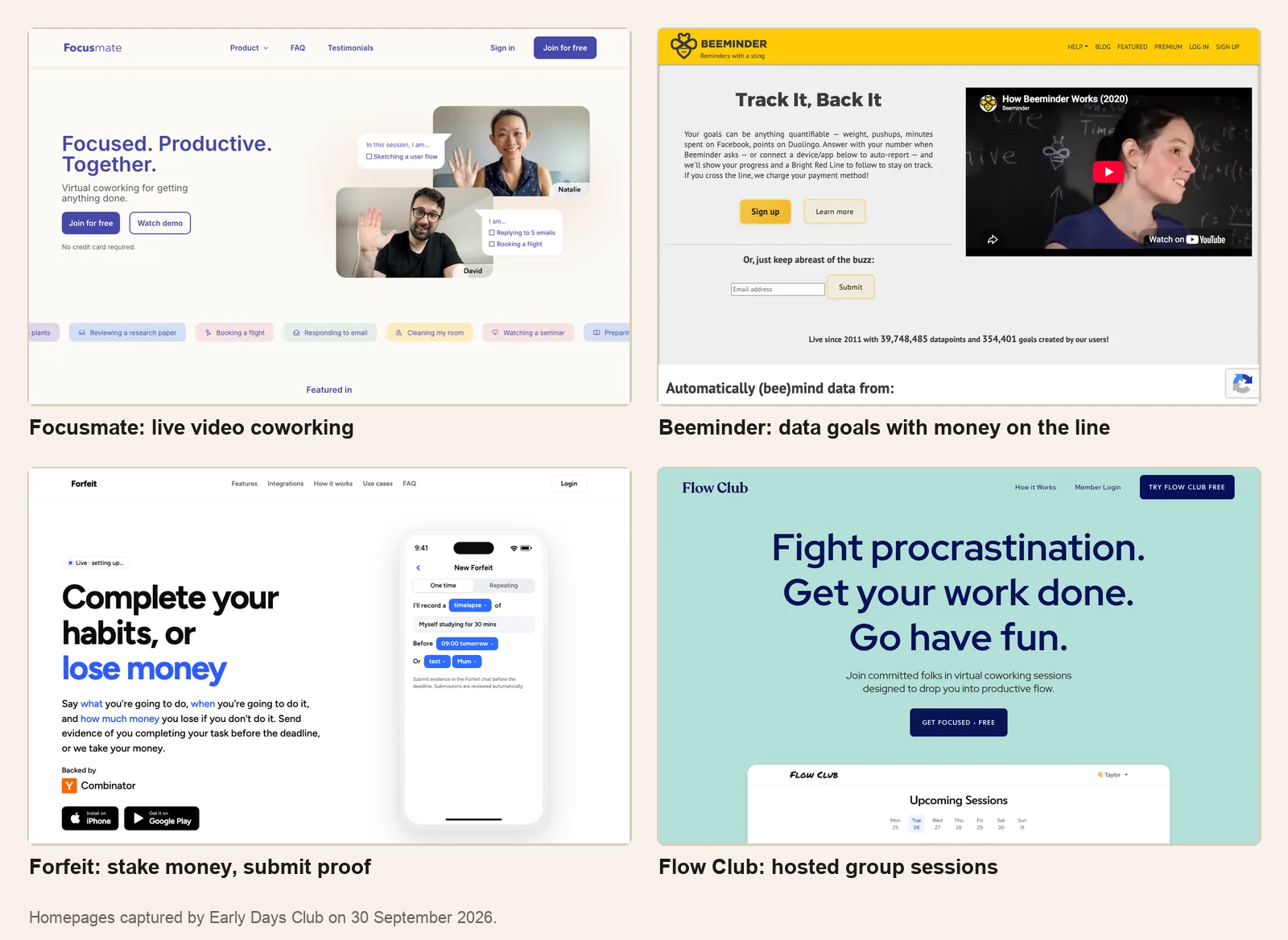
The three kinds of accountability app
Accountability apps come in three kinds: coworking apps that give you company, coaching apps that give you a person, and commitment apps that put your money on the line. Picking the right kind matters more than picking the right app inside it.
1. Coworking and body doubling: Focusmate and Flow Club
These apps give you company while you work. You book a session, state what you'll do, work with your camera on, and report back at the end. Focusmate pairs you with one person for 25, 50 or 75 minutes. Its free plan gives 3 sessions a week with no card, and Plus is $8 a month billed yearly or $12 billed monthly.
Flow Club runs larger hosted sessions from 30 minutes to 3 hours, and 60 minutes is its most popular length. Its own FAQ describes the ritual well:
“At the start of a session, the host welcomes everyone and asks each person “what are you working on?” You say your goals out loud (or type it into chat).”
Both are strong for today's work. Neither follows up next week, so they help with starting rather than with a habit that runs for months.
2. A human coach: GoalsWon
GoalsWon matches you with a trained accountability coach who reads your daily chat check-ins and replies every day, plus a monthly video call. It costs $90 a month, or $720 a year (which works out to $60 a month), with a free trial on both plans. That is the most expensive option here, and also the only one where a named person notices when you go quiet.
3. Money on the line: Beeminder, Forfeit and stickK
These apps use loss aversion: losing money feels worse than gaining the same amount feels good. Beeminder, live since 2011, charts a number you report (pushups, minutes, words) against a "Bright Red Line", and charges your card if you cross it. Forfeit asks you to stake money on a task and send evidence before the deadline, and says a real human reviews every appeal within 12 hours. stickK was started by two Yale professors, Dean Karlan and Ian Ayres, and lets you name a referee who confirms your reports.
stickK has published the most-quoted number in this category. Its co-founder Jordan Goldberg has said that users who put money on the line and have a referee achieve their goals 78% of the time, compared with 35% for users who put no money down. Treat that as a company figure rather than a controlled study: people who stake money may be more committed to begin with.
What is the best free accountability app?
For most people, Focusmate's free plan is the best free accountability app: 3 live sessions a week, no credit card, and a real person on the other side. stickK is also free for individual users if you only want a commitment contract and a referee. If you want a human partner rather than an app, subreddits like r/GetMotivatedBuddies exist to match strangers with the same goal, at no cost.
The money-on-the-line apps can be "free" too, in the sense that you pay nothing as long as you keep your word. That's the point of them.
Accountability apps vs a peer group
Apps are good at reminding. People are good at caring. The trade-off looks like this:
| Accountability app | Peer group or partner | |
|---|---|---|
| Setup time | Minutes | Days to weeks to find the right people |
| Cost | Free to $90 a month | Usually free |
| What happens when you skip | A charge, a notification or a coach message | Someone you know asks what happened |
| Advice on the work itself | Rare, except a coach | Common, if members are at your stage |
| Survives a busy month | Yes, software doesn't get busy | Only if the group is bigger than two |
| Helps your work get seen | No | Yes, if members are your audience |
My view: use an app for goals that live in private (workouts, deep work, a writing streak) and a peer group for goals that live in public, where the other people's attention is part of the result. The guide to running an accountability group covers the peer side in detail, and the accountability partner guide covers finding one person.
How to choose an accountability partner app
Choose an accountability app by deciding what would actually make you follow through, then testing that type free for two weeks before paying.
- Write the goal as something checkable. "Write 500 words a day" can be checked. "Be more productive" can't, and no app will fix that.
- Decide what should happen when you skip. If a lost $20 would change your behaviour, try Beeminder, Forfeit or stickK. If company would, try Focusmate or Flow Club. If only a person would, try a coach or a peer group.
- Start on the free tier or trial. Focusmate's free plan and the GoalsWon trial let you test the format before paying.
- Run it for two weeks, then review. Count the days you did the goal. If the count didn't move, switch type rather than switching to a similar app.
- Add a human if the goal is public. For posting, launching or selling, pair the app with people who will actually see the work.
What apps can't do for a LinkedIn posting habit
If your goal is to post on LinkedIn every week, an app can confirm you posted. It can't change what happens next. Most founders don't quit posting because they forgot. They quit because the post went out to silence, and nobody was there to see it.
That's the gap Early Days Club was built for. It's a members-only club for founders and consultants growing on LinkedIn, and it works like an accountability group for your posts. You pick up to three audiences you want to reach, and members who match them see your posts in a short daily list in the extension's side panel.
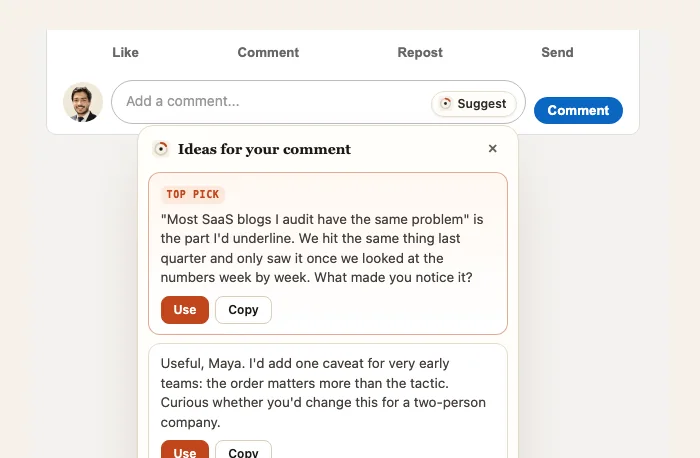
- Comment ideas you edit yourself. Nothing is ever posted for you. Every like and comment is a member's own choice, in their own tab.
- Support over the day. Support arrives as members come online, not all at once.
- A light rule. Keep supporting members and your posts keep going on lists. Go quiet and they pause until you're back.
For how much to post in the first place, see how often to post on LinkedIn with a small audience.
Frequently asked questions
What is the best free accountability app?
Focusmate's free plan is the strongest free option: 3 live video coworking sessions a week with no credit card. stickK is free for individual users if you want a commitment contract and a referee. Beeminder and Forfeit cost nothing as long as you keep your commitments.
Is there an app to find an accountability partner?
Focusmate pairs you with a new partner for each session, and Flow Club puts you in hosted group sessions. If you want one ongoing partner rather than a new stranger each time, communities like r/GetMotivatedBuddies on Reddit or a founder group matched by stage work better.
Is there an accountability app for workouts?
Beeminder works well for workouts you can count, such as runs or pushups, and charges you if you fall behind. Forfeit asks for proof, such as a photo or a location check at the gym, before a deadline. A local training partner is still the classic option.
Do accountability apps with money actually work?
They can. stickK's co-founder has said users who stake money and have a referee reach their goals 78% of the time, compared with 35% for those with no money down. That's a company figure, and it may partly reflect that committed people choose to stake money.
Are paid accountability coaches worth it?
For some people, yes. GoalsWon costs $90 a month, or $60 a month on the annual plan, for a human coach who replies daily. It suits people who need a real person to notice. Try the free trial first and track whether you actually did more.
Can an app replace an accountability partner?
For private goals, often yes. For public goals like posting online or launching a product, not fully. An app confirms you did the task. A partner or group can react to the work, give feedback and, when they're your audience, help it get seen.
I build products for founders who grow on LinkedIn, including LigoSocial and Early Days Club. The idea behind the club came from my own two-week experiment: I stopped posting and left a few thoughtful comments a day instead, and my profile views tripled. These articles are what I have learned about showing up consistently when your audience is still small.